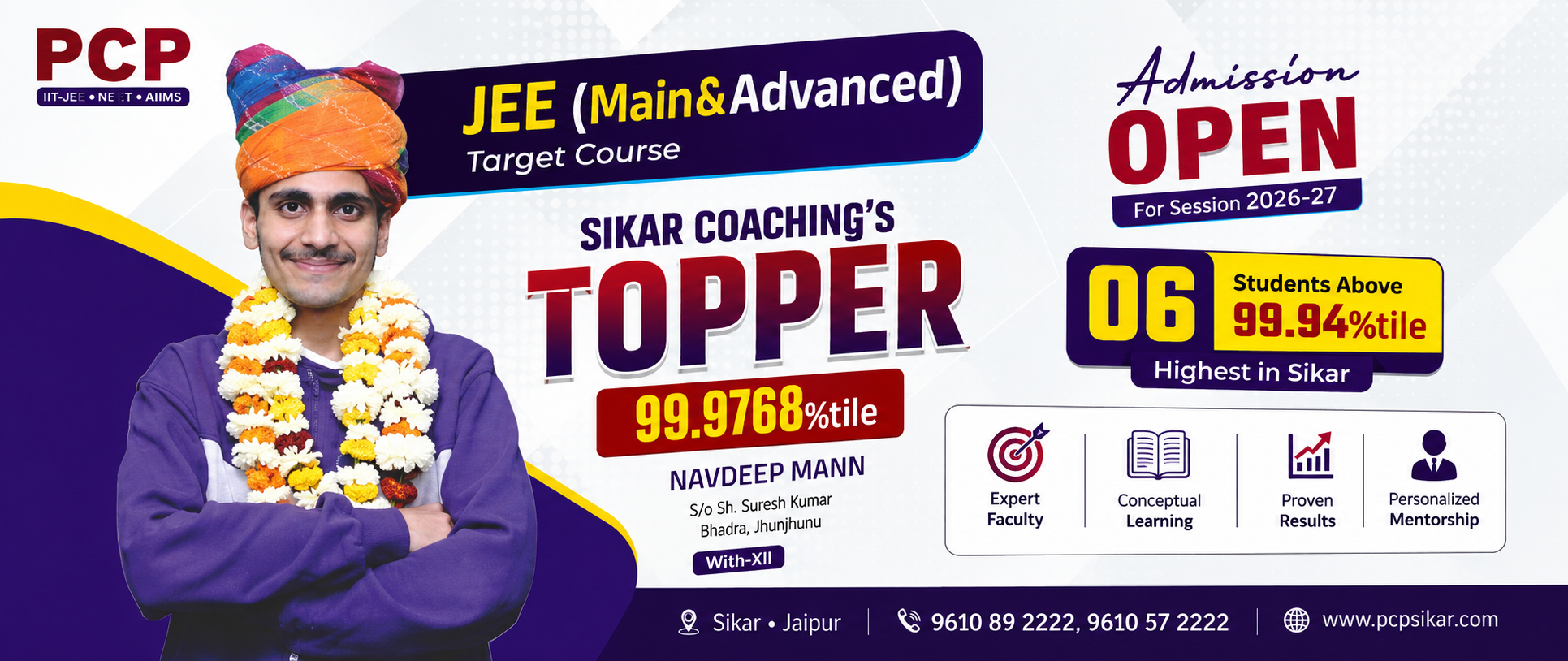
PCP Sikar JEE Main & Advanced Target Course: Focused Preparation for Engineering Entrance Success
For students aiming to build a career in engineering and compete for admission to leading technical institutions, preparation for JEE Main and JEE Advanced requires more than completing a syllabus. It demands strong fundamentals, regular problem-solving, strategic revision, time management, and continuous performance evaluation.
PCP Sikar’s JEE Main & Advanced Target Course is designed for aspirants who want a focused preparation pathway built around the demands of competitive engineering examinations. PCP’s published academic material identifies a “XIII-Target Course” alongside its XI-XII Foundation and IX-X Pre-Foundation programmes.
For detailed course information, students can visit the requested PCP page: PCP Sikar – Best Coaching for JEE in Sikar
Is PCP Sikar’s JEE Course Right for You?
Start Early. Build Strong. Aim Higher.
JEE preparation is not just about studying more—it is about understanding concepts, solving the right questions and preparing consistently.
PCP Sikar’s Class 11th & 12th JEE Main & Advanced Foundation Course can be a suitable choice for students who:
✅ Want to start JEE preparation early
✅ Are serious about pursuing engineering at a leading institute
✅ Want stronger concepts in Physics, Chemistry and Mathematics
✅ Need a structured study routine
✅ Want regular tests and performance evaluation
✅ Want guidance throughout their JEE preparation
✅ Want to improve speed, accuracy and problem-solving ability
✅ Are preparing for both JEE Main and JEE Advanced
One Course. Two Important Years. One Focus – JEE Success.
Beginning systematic preparation in Classes 11th and 12th gives students an opportunity to learn concepts thoroughly, practise consistently and identify their strengths and weaknesses well before the examination.
Why Choose a Target Course for JEE Preparation?
JEE preparation becomes particularly important when students are approaching their examination year and need to convert their existing knowledge into speed, accuracy and exam-oriented performance.
A Target Course can help students move through a structured cycle:
Concept Revision → Problem Solving → Testing → Performance Analysis → Doubt Resolution → Revision
Instead of studying topics independently, aspirants can follow a more organised preparation system where every stage of preparation contributes toward the final examination.
JEE Main & Advanced Preparation at PCP Sikar
PCP Sikar has developed a competitive-exam ecosystem around IIT-JEE, NEET and Olympiad preparation, with its published material listing Target, Foundation and Pre-Foundation courses.
The JEE Target Course can be positioned as a focused programme for students who want to strengthen their preparation across the three core JEE subjects:
- Physics
- Chemistry
- Mathematics
The objective is not simply to cover chapters but to develop the ability to apply concepts to different levels of questions.
JEE Main and JEE Advanced: Understanding the Difference
A good preparation strategy needs to recognise that JEE Main and JEE Advanced test students differently.
JEE Main
JEE Main serves as a major engineering entrance examination and also forms the pathway for candidates seeking eligibility for JEE Advanced.
Preparation therefore requires:
- Strong command of the prescribed syllabus
- Efficient question-solving
- Accuracy under time pressure
- Regular mock-test practice
- Revision of important formulas and concepts
- Familiarity with computer-based examination conditions
Students should always refer to the current official JEE Main information bulletin for the latest examination rules and pattern. The official JEE Main website provides the 2026 Information Bulletin.
JEE Advanced
JEE Advanced requires a deeper level of conceptual understanding and analytical thinking.
For 2026, JEE Advanced consists of Paper 1 and Paper 2, each of three hours, with Physics, Chemistry and Mathematics sections in both papers. Appearing in both papers is compulsory. The official brochure also states that questions are designed to test comprehension, reasoning and analytical ability.
This makes it important for serious aspirants to prepare beyond formula-based question solving.
Subject-Wise Preparation Strategy
1. Physics – Build the Ability to Apply Concepts
Physics can become a high-scoring subject when students understand the principles behind formulas rather than memorising them.
A focused JEE preparation approach should include:
- Conceptual understanding
- Formula revision
- Numerical problem-solving
- Multiple approaches to difficult questions
- Previous-question analysis
- Regular timed practice
- Error analysis after tests
Important areas should be revised repeatedly instead of being studied only once.
The goal should be to answer questions with clarity and controlled calculation, particularly when several concepts are combined in a single problem.
2. Chemistry – Balance Concepts, Reactions and Practice
Chemistry requires a different preparation style because the subject combines conceptual, numerical and memory-oriented components.
A systematic approach can include:
Physical Chemistry
Focus on concepts, equations, calculations and repeated numerical practice.
Organic Chemistry
Develop reaction understanding and connect related concepts rather than treating every reaction as an isolated fact.
Inorganic Chemistry
Maintain systematic revision and develop familiarity with important concepts and prescribed material.
The Target Course approach should therefore combine learning + practice + revision + testing, allowing students to identify which portions need additional attention.
3. Mathematics – Develop Problem-Solving Depth
Mathematics often requires students to recognise the correct approach before they begin lengthy calculations.
A strong preparation plan should emphasise:
- Concept clarity
- Formula application
- Question variety
- Short and long-form problem solving
- Timed practice
- Difficulty-level progression
- Mistake analysis
Students should gradually move from straightforward questions to problems that require multiple concepts or unconventional approaches.
For JEE Advanced in particular, analytical thinking is important because the official examination is designed to assess comprehension, reasoning and analytical ability.
Regular Testing: The Core of Competitive Preparation
One of the most important differences between ordinary academic preparation and entrance-exam preparation is continuous testing.
PCP Sikar’s published JEE test-series material describes a structured testing system for JEE Main and Advanced, including full-syllabus tests, revision-oriented tests and discussion/support sessions.
Testing can help students answer important questions:
- Which chapters are strong?
- Which concepts are repeatedly causing mistakes?
- Is the student losing marks through calculation errors?
- Is time management becoming a problem?
- Which subject requires more attention?
- Are mistakes caused by lack of knowledge or incorrect question selection?
A test becomes much more useful when students analyse it after completion rather than simply checking the score.
Learn From Every Test
A useful post-test analysis system can divide mistakes into four categories:
Conceptual Mistakes
The underlying concept is not clear.
Calculation Mistakes
The method is correct but an arithmetic or calculation error occurred.
Application Mistakes
The student knows the concept but struggles to identify how to apply it.
Time-Management Mistakes
Too much time was spent on particular questions.
This classification can make revision much more targeted.
Concept Building + Advanced-Level Thinking
JEE preparation should not become a race to complete the maximum number of chapters.
A better objective is:
Understand → Apply → Challenge → Analyse → Improve
For JEE Main, students need speed and accuracy. For JEE Advanced, they also need deeper reasoning and flexibility in approaching unfamiliar problems.
Therefore, a good Target Course should help students gradually transition from chapter-wise learning to mixed-concept and examination-oriented problem solving.
Revision Should Be Planned, Not Random
Many students revise only when an examination is close. This can result in unnecessary pressure.
A structured revision strategy can divide preparation into:
First Revision
Revisit concepts and identify weak chapters.
Second Revision
Solve representative questions and previous-exam-style problems.
Third Revision
Focus on formulas, important concepts, mistakes and frequently tested areas.
Final Revision
Prioritise high-value revision material and mock-test analysis rather than attempting to learn everything from the beginning.
This approach helps students turn their preparation into a continuous improvement process.
Why Test Analysis Matters as Much as Test Taking
Suppose a student scores 160 marks in one mock test and 180 in another. The improvement is useful, but the more important question is why the score changed.
For example:
| Performance Area | What to Analyse |
|---|---|
| Accuracy | How many questions were incorrect? |
| Speed | Which sections consumed excessive time? |
| Concepts | Which chapters produced repeated mistakes? |
| Question Selection | Were difficult questions attempted unnecessarily? |
| Revision | Which previously studied topics were forgotten? |
| Calculation | Were marks lost through avoidable errors? |
This analysis gives students actionable information for the next study cycle.
PCP Sikar’s JEE Test Preparation Ecosystem
PCP’s published JEE Test Series 2026 information highlights features such as:
- JEE Main and Advanced-oriented testing
- Full-syllabus examinations
- Revision classes
- Discussion sessions
- Video solutions
- Doubt classes
- Preparation aligned with NTA and IIT examination patterns
The published material also describes separate test-series structures, including Arjuna for JEE Main preparation and Drona for JEE Advanced preparation.
These elements can complement a Target Course by giving students opportunities to evaluate their preparation under examination-like conditions.
A Practical JEE Target-Course Study Cycle
Students can structure their preparation around the following weekly cycle:
Monday–Tuesday
Learn & Revise
Strengthen concepts and revise previously studied topics.
Wednesday–Thursday
Practice
Solve progressively difficult questions and identify weak areas.
Friday
Doubt Resolution
Review questions that could not be solved independently.
Saturday
Revision + Mixed Practice
Combine questions from different chapters.
Sunday
Test + Analysis
Take a timed test and analyse mistakes afterward.
The exact timetable should be adjusted according to the student’s current preparation level and examination schedule.
Who Can Consider a JEE Target Course?
A Target Course can be particularly relevant for students who:
- Are preparing seriously for JEE Main
- Want to continue toward JEE Advanced
- Have completed substantial portions of the syllabus
- Need structured revision
- Want regular examination practice
- Need help identifying weak areas
- Want to improve speed and accuracy
- Prefer a competitive learning environment
Students should choose a programme based on their current academic level, preparation status and individual requirements rather than relying only on promotional claims.
PCP Sikar JEE Advanced Preparation
JEE Advanced demands a different mindset from routine classroom examinations.
The official 2026 brochure states that the examination includes two compulsory three-hour papers, with Physics, Chemistry and Mathematics sections, and questions designed around comprehension, reasoning and analytical ability.
Consequently, Advanced preparation should include:
Deep Concepts + Multi-Concept Questions + Analytical Thinking + Time Management + Test Analysis
PCP Sikar’s published JEE Advanced 2025 result article reports 350+ students selected for JEE Advanced 2025, with six students securing positions within the All India Top 1500, according to the institute’s own published report.
Results can demonstrate an institute’s past performance, but individual outcomes will always depend on a student’s preparation, consistency and examination performance.
Why Sikar Is a Major Choice for Competitive Exam Preparation
Sikar has developed into a prominent education and coaching destination for students preparing for competitive examinations.
For JEE aspirants, choosing the right institute should involve more than looking at rankings or advertisements. Students and parents should evaluate:
- Faculty and teaching methodology
- Academic schedule
- Test frequency
- Doubt-solving mechanism
- Study material
- Performance tracking
- Revision system
- Batch environment
- Previous results
- Accessibility and daily routine
A suitable learning environment should make it easier for students to remain consistent throughout the preparation period.
How to Make the Most of a JEE Target Course
Joining a coaching programme is only one part of preparation. Students should actively participate in the learning process.
1. Attend classes consistently
Avoid creating gaps between connected concepts.
2. Revise on the same day
A short revision session can help reinforce classroom learning.
3. Practise independently
Coaching cannot replace individual problem-solving.
4. Maintain an error notebook
Record recurring conceptual and calculation mistakes.
5. Analyse every test
Treat every test as feedback rather than simply a score.
6. Revise weak areas repeatedly
Repeated mistakes indicate areas requiring additional attention.
7. Maintain consistency
Regular effort is generally more sustainable than irregular intensive study sessions.
JEE/NEET Success Stories from Our Students
They Started With Preparation. They Finished With Results.
Behind every JEE or NEET result is a journey of classes, practice, tests, mistakes, improvement and consistency.
Showcase verified students from this batch here:
🏆 Our Achievers
[Student Name]
JEE Main [Year]
⭐ [Percentile / Rank]
[Student Name]
JEE Advanced [Year]
⭐ [AIR / Achievement]
[Student Name]
NEET [Year]
⭐ [Score / Rank]
[Student Name]
JEE Main [Year]
⭐ [Percentile / College]
Your Result Story Could Be Next
PCP Sikar provides a structured academic environment where students can focus on concepts, regular practice, testing and continuous improvement throughout their preparation.
Start preparing today. Stay consistent. Keep improving.
Feedback From Our Students & Parents
Real Experiences. Real Preparation Journeys.
What matters most is how students experience their preparation journey.
⭐ Student Feedback
“The regular practice and faculty guidance helped me become more confident in solving JEE-level questions.”
— [Student Name]
⭐ Parent Feedback
“The disciplined study environment and regular assessments helped us keep track of our child’s preparation.”
— [Parent Name]
⭐ Student Feedback
“The structured approach helped me stay consistent with my Physics, Chemistry and Mathematics preparation.”
— [Student Name]
Frequently Asked Questions
What is the PCP Sikar JEE Main & Advanced Target Course?
It is a focused JEE preparation pathway intended for students preparing for competitive engineering entrance examinations. PCP’s published programme material lists a XIII-Target Course within its IIT-JEE preparation ecosystem.
Does JEE preparation include both Main and Advanced?
A serious IIT-oriented preparation strategy can target both examinations. However, students should understand that JEE Advanced places a greater emphasis on reasoning, comprehension and analytical problem solving.
Which subjects are covered?
JEE preparation covers Physics, Chemistry and Mathematics.
Is testing important for JEE preparation?
Yes. Regular tests can help students measure preparation, improve time management and identify weak areas. PCP’s published JEE Test Series information includes full-syllabus tests, revision components and discussion/support sessions.
Where can I get information about PCP Sikar’s JEE coaching?
Students can visit the requested PCP page for the institute’s course and admission information:
PCP Sikar JEE Coaching – Course Information
Start Your JEE Preparation With a Clear Target
JEE Main and JEE Advanced preparation is a long-term academic process in which conceptual strength, disciplined practice, regular testing and continuous improvement work together.
A well-structured Target Course can provide a framework for students who want to turn their preparation into an organised examination strategy. PCP Sikar’s published JEE material reflects an ecosystem that includes Target-level preparation and dedicated JEE Main/Advanced testing programmes.
For students searching for JEE coaching in Sikar, the right decision should ultimately come from comparing the programme structure, teaching approach, testing system and the student’s own academic requirements.
PCP Sikar – JEE Main & Advanced Target Course
Build stronger concepts. Practise smarter. Analyse every test. Improve consistently.
Course: JEE Main & Advanced Target Course
Subjects: Physics, Chemistry & Mathematics
Focus: Concept Building • Problem Solving • Revision • Testing • Performance Analysis
Visit PCP Sikar’s JEE Coaching Page
JEE Main & Advanced Foundation Course – FAQs
Q1. What is the PCP Sikar JEE Foundation Course?
It is a structured coaching programme for Class 11th and 12th students preparing for JEE Main and JEE Advanced.
Q2. Why should students start JEE preparation from Class 11th?
Starting early provides more time for concept development, question practice, revision and systematic preparation.
Q3. Is the course useful for JEE Main as well as JEE Advanced?
Yes. The programme is designed to support preparation for both examinations through conceptual learning and competitive-level practice.
Q4. What subjects are included in JEE preparation?
JEE preparation primarily covers Physics, Chemistry and Mathematics.
Q5. Will students get practice and tests?
Practice and assessment are essential parts of JEE preparation. The exact test schedule and format depend on the current batch.
Q6. Is the course suitable for students who are weak in some subjects?
Students who want to strengthen their fundamentals can benefit from a structured learning approach, regular practice and continuous academic guidance.
Q7. Can students prepare for JEE along with their school studies?
Yes. The course is intended for school-going students and focuses on systematic preparation alongside their academic curriculum.
Q8. What makes consistent practice important for JEE?
Regular practice helps students understand concepts better, develop problem-solving skills and identify areas requiring further improvement.
Q9. How can I get information about the current batch?
Contact PCP Sikar for the latest information regarding batch timings, admission, fees, course duration and availability.